Physicists detect rare beauty particle decay after 42-year search
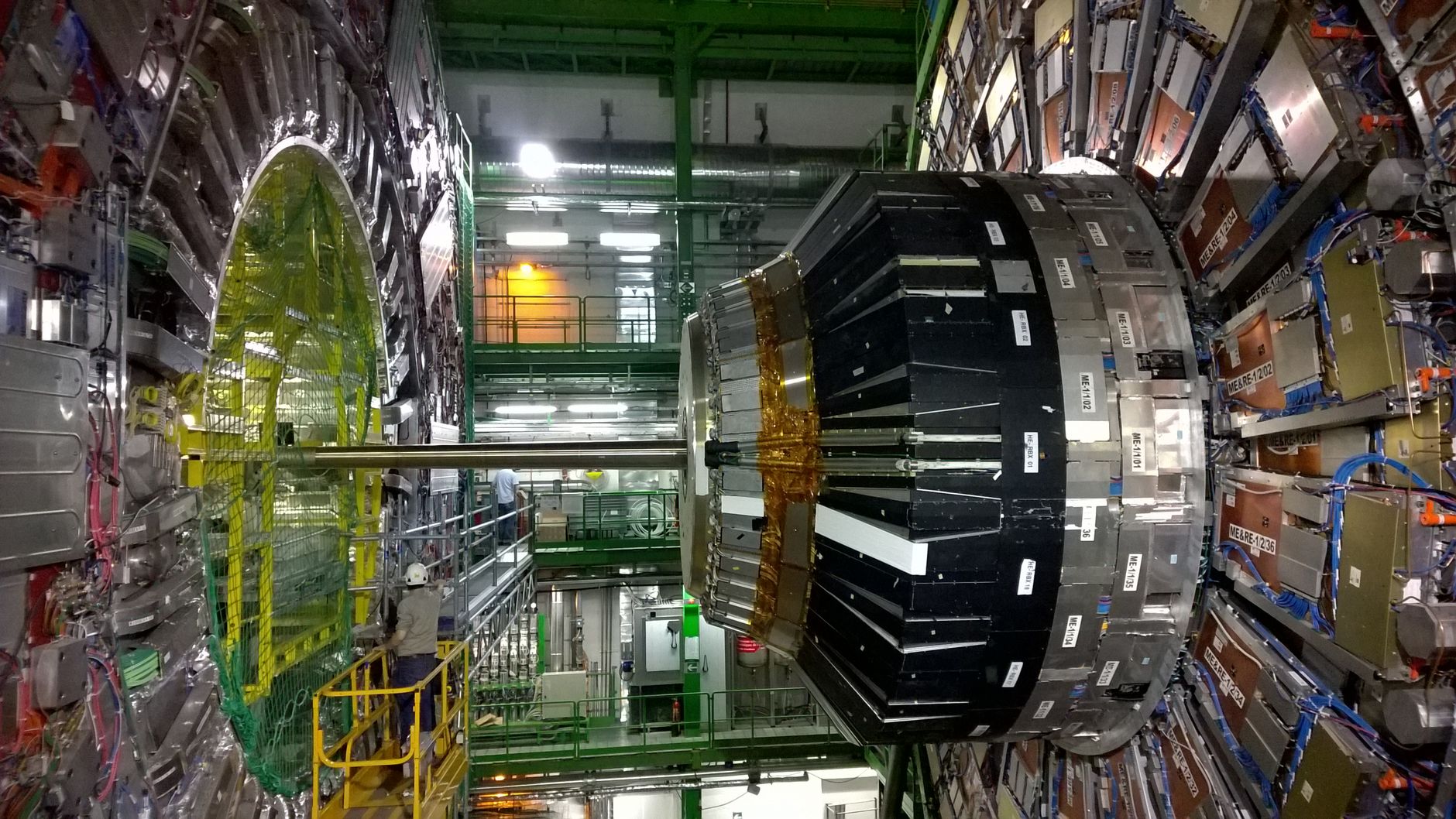
- Physicists found evidence of a decay occurring once in 10 billion beauty particles.
- The discovery follows a 42-year search using the upgraded LHCb experiment.
- The measurement is consistent with the Standard Model of particle physics.
- UK universities played a major role in the experiment's construction and upgrade.
- Future research aims to collect 10 times more data by 2036.
Physicists at the Large Hadron Collider have identified evidence of a rare beauty particle decay that occurs approximately once for every 10 billion beauty particles. This discovery follows a search that has spanned more than 42 years. The international LHCb collaboration obtained the data through the upgraded LHCb experiment at the Large Hadron Collider. University of Manchester physicists contributed to finding evidence of the rare 'Bd to mu mu' particle decay at the facility.
The findings align with the predictions of the Standard Model.
The Garden of Hope is an immersive display featuring 2,500 pre-lit white roses, each bearing a personal tribute. The public can visit the site daily from 4pm to 7pm, starting 5 December and ending 18 December.
Members of the public can dedicate a rose for a minimum donation of 20 pounds. This donation includes a personalised message and a commemorative Christmas tree decoration.
Funds raised from the event will support the construction of a new multi-million pound scanning centre at The Christie. The facility will provide increased capacity and state-of-the-art imaging technology.
The Malones support the charity due to their personal history with The Christie, where Julie’s father, Cyril (Sid), received experimental treatment in the late 1990s that provided six additional months of life. Julie Malone noted that those extra six months meant everything to the family.
Tom Malone said the installation is a way to remember those lost, celebrate those still present, and support everyone affected by cancer. He called it a pleasure to give back to the work done at The Christie.
Statistical significance and Standard Model alignment
The current measurement aligns with the predictions of the Standard Model. It achieved a statistical significance of 3.2 sigma.
Exploring the Zeptoverse and beauty quarks
Scientists hope to find new particles and forces at this scale, which they call a zeptometer.
These particles exist for only a fraction of a second.
Researchers provided the most precise measurements yet of the Bs to mu mu decay, a rare process first observed by the LHCb in 2015.
UK contributions to the LHCb upgrade
Scientists from the University of Manchester and the University of Liverpool played significant roles in the LHCb experiment and its upgrade. The project involved 1,900 international members over 15 years, with the UK providing the largest national contribution.
The UK LHCb collaboration includes researchers from 10 universities and the STFC Rutherford Appleton Laboratory. The Science and Technology Facilities Council funds the experiment as part of UK Research and Innovation.
The upgraded LHCb experiment collects data at five times the rate of the previous version. University of Liverpool researchers assembled the Vertex Locator, or VELO, a silicon pixel detector central to the upgraded experiment.
The VELO tracks particles from collisions to allow scientists to determine the precise location of particle creation and decay.
Leadership and expert perspectives
Parkes became a Fellow of the Royal Society earlier in 2026 for his work on the project.
Stefano De Capua, also of The University of Manchester, led the construction of the detectors while collaborating with nearly 90 UK companies to train scientists and engineers.
A representative from The University of Liverpool said the ability to see such a rare decay is a result of the skills and craftsmanship of the staff who built the Vertex Locator.
Future research and data collection
The High-Luminosity Large Hadron Collider upgrade will increase luminosity by a factor of five to seven, enabling the collection of 10 times more data between 2026 and 2036.
The experiment will collect data into the early 2030s, with a potential further upgrade increasing data collection rates by another factor of 10.
Mechanics of the Large Hadron Collider
The Large Hadron Collider generates up to 1 billion proton-proton collisions every second.
The machine functions by colliding two high-energy particle beams that travel in opposite directions within separate pipes at speeds near the speed of light.
Researchers focus on the 'Bd to mu mu' decay, a process where a beauty particle decays into two muons.
This decay is predicted to occur once in every 10 billion beauty particles, a phenomenon researchers have sought for over 40 years.
Frequently Asked Questions
- Physicists step closer to the 'Zeptoverse' after 42-year particle search (phys.org)
- Manchester physicists step closer to the ‘Zeptoverse’ after 42-year particle search (manchester.ac.uk)
- Liverpool physicists help uncover evidence of rarest particle decay after 42-year search (news.liverpool.ac.uk)
- Step inside the zeptoverse: British scientists use the Large Hadron Collider to peer inside a minuscule world where exotic particles may be hiding | Daily Mail (dailymail.com)
- Tom and Julie Malone open The Christie Charity’s Garden of Hope (aboutmanchester.co.uk)
Add NewsPulse Time as a preferred source on Google